
How to Choose a Restoration Company in California: CSLB License Checks and Red Flags
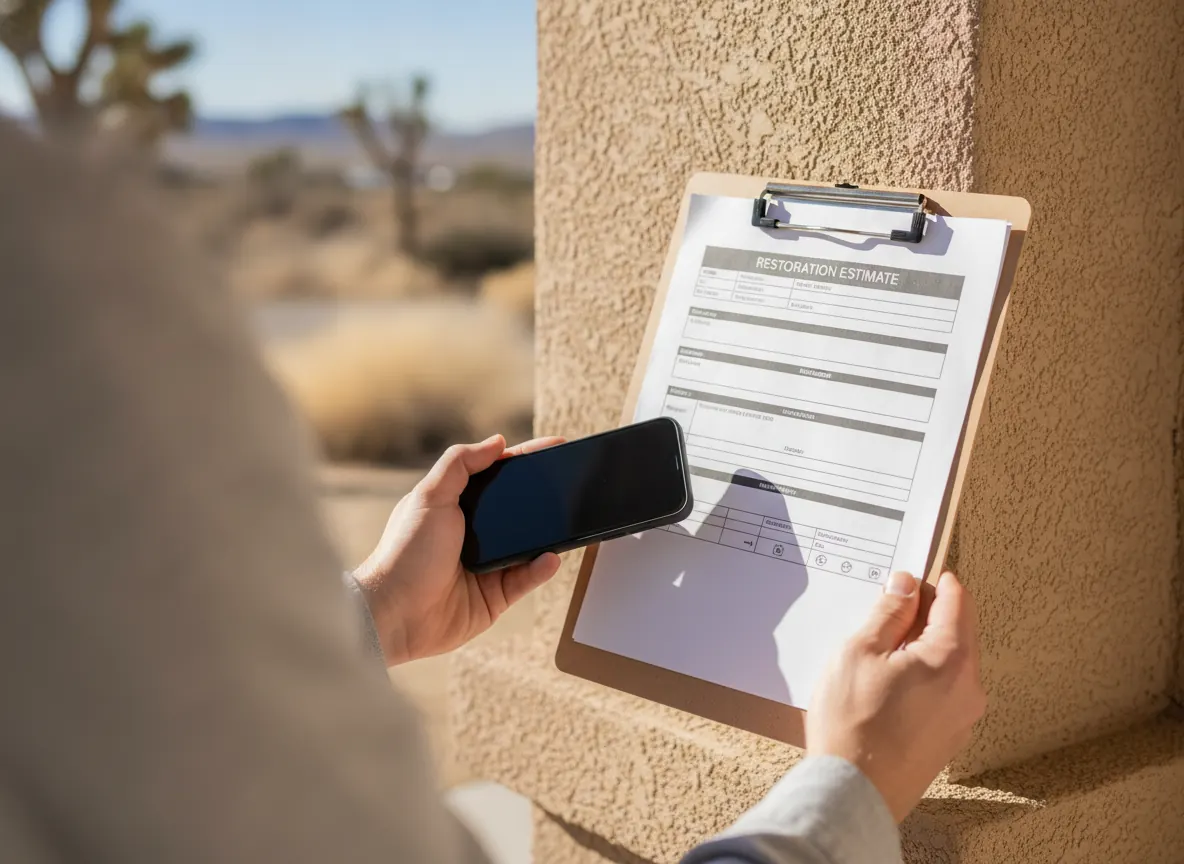
Short answer: before you hire anyone to dry out, clean up or rebuild after water or fire damage in California, get the company's CSLB license number, look it up on the Contractors State License Board site, and get a written contract. In California, a repair job of $1,000 or more, any job that needs a building permit, or any job where the worker brings a crew must be done by a CSLB-licensed contractor (Business and Professions Code §7048). Most real water and fire losses pass that line quickly.
This guide explains how to check a license, which license types you may see, the contract rules that protect you and the red flags to watch for in Lancaster, Palmdale and the rest of the Antelope Valley. It is general information, not legal advice.
Antelope Valley Fire & Water Damage is a free quote service, not a restoration company, a contractor or an insurance adjuster. It doesn't do cleanup, drying, mold work or repairs, and it isn't affiliated with the City of Lancaster, the City of Palmdale, Los Angeles or Kern County, the Los Angeles County Fire Department, the Kern County Fire Department, FEMA, your utility or your insurance company. Describe the damage once, and independent local restoration companies, which may pay to receive requests, can reply with quotes. You sign any contract directly with the company you choose and pay that company directly.
Antelope Valley Fire & Water Damage doesn't check or verify licenses. Each company is responsible for its own CSLB licensing, insurance, pricing and work, so the steps below are worth doing with any company that replies to you.
Do this before you sign.
- Ask for the CSLB license number in writing.
- Check any contractor's license at cslb.ca.gov or call 800-321-2752 before you sign.
- Make sure the name on the license matches the name on the estimate and contract.
- Get a written scope and contract, and never sign one with blank spaces.
When does a restoration company need a CSLB license?
California's minor-work exemption now stops below $1,000. Under B&P §7048, the License Law doesn't apply to a project where the total price for labor, materials and everything else is under $1,000 and the work doesn't need a building permit. The exemption is lost if a job is split up to get under the limit, if the person advertises as a contractor, or if they employ someone else to do or help with the work.
In practice, drying more than a small spill usually costs over $1,000, any repair that needs a permit requires a licensed contractor whatever the price, and a company that brings a crew needs a license even for smaller jobs.
Older guides and some CSLB pages still mention a $500 threshold. The statute changed on January 1, 2025, and the current figure in B&P §7048 is $1,000.
How to look up a license
Use the "Check a License" search on cslb.ca.gov. You can search by license number, business name or personal name. Look at:
- Status. Is the license active, or is it expired, suspended or revoked?
- Name and address. Does it match the company on your estimate?
- Classification. Does the license type fit the work in the contract?
- Other details the lookup shows. If something doesn't make sense, call CSLB at 800-321-2752.
California also requires contractors to show their license number in their ads (B&P §7030.5), and it is a misdemeanor to advertise for work covered by the License Law without a valid license (B&P §7027.1). A company that won't give you a number is telling you something.
Which license types do restoration companies hold?
There is no CSLB classification called "water damage restoration," "fire restoration" or "mold." Restoration companies hold the classes that fit the work they do, so the right question is whether the license fits the specific job in your contract. Classes you may see include:
- B, General Building, for work involving at least two unrelated building trades (B&P §7057), such as drywall, framing and flooring together.
- B-2, Residential Remodeling.
- C-36, Plumbing, for the pipe repair itself.
- C-39, Roofing, for roof repairs after a leak or fire.
- C-20, HVAC, for heating, cooling and ductwork, including evaporative cooler work.
- C-10, Electrical, C-33, Painting, C-22, Asbestos Abatement and C-61, Limited Specialty.
No single class is "required" for restoration. If you're unsure, ask the company or CSLB.
California doesn't issue a mold-specific license, and the state hasn't set a safe mold level. CSLB licensing still applies to remediation and rebuild work of $1,000 or more. See mold remediation after water damage for questions to ask about mold work.
What about IICRC certification?
IICRC certification is a private certification from a training organization, not a state license. It tells you which cleaning and drying standards a company says it follows, but it doesn't replace a CSLB license. Ask about both.
Why the license protects you
- An unlicensed contractor can't sue to collect payment in California, and you can sue to recover what you paid one (B&P §7031).
- After a declared disaster, contracting without a license to repair damage is a felony-level crime in California (B&P §7028.16), and the homeowner counts as a crime victim whether or not they knew.
- A licensed contractor is the one who can pull permits for repairs. Lancaster and Palmdale run their own building departments. Quartz Hill, Lake Los Angeles, Littlerock, Acton, Agua Dulce, Sun Village and Leona Valley go through LA County Public Works' Antelope Valley office in Lancaster. Rosamond and Mojave go through Kern County. Check the city's or county's website for current contact details.
Contract rules to know
A home improvement contract over $500 must be in writing with the notices California requires (B&P §7159). A few rules matter most after water or fire damage:
- California caps a contractor's down payment at $1,000 or 10% of the contract, whichever is less, and payments can't get ahead of the work (B&P §7159.5).
- Most home improvement contracts signed at your home come with a three-business-day right to cancel, or five days if you're 65 or older (Civil Code §1689.6).
- If you sign a contract to repair damage from a declared emergency, such as a fire or flood, you have seven business days to cancel (B&P §7159; Civil Code §1689.6).
- For 180 days after a declared emergency, California generally bars contractors from raising repair and cleanup prices more than 10% over what they charged before (Penal Code §396).
Red flags
- No license number, or a number that belongs to a different name.
- A large deposit up front, cash only, or pressure to pay before work starts.
- An offer to "take care of" your deductible. In California, a contractor generally can't offer you a discount meant to cover your insurance deductible unless the work matches what your insurer approved (Penal Code §551).
- A promise to "handle" or "settle" your insurance claim. Only a public adjuster licensed by the California Department of Insurance can be paid to handle your claim for you. Verify licenses at 1-800-967-9331.
- A contract with blank spaces, no written scope, or no cancellation notice.
- Door-to-door pressure to sign on the spot right after a storm or fire.
- Talk of your insurer "requiring" a particular company. California homeowners have the right to choose their own licensed contractor (Insurance Code §10103.5; 10 CCR §2695.9).
Questions to ask every company
- What is your CSLB license number, and which classifications does it cover?
- Does your team hold IICRC certification, and which standard do you follow?
- Can I see a written scope with line items, equipment and expected drying days?
- Will you take moisture readings and keep drying logs I can share with my insurer?
- Who pulls the permit if one is needed?
- Which parts of the work, such as plumbing or roofing, are done by someone else and billed separately?
For what the work itself involves, see water damage restoration and water extraction and fire damage restoration and board-up. For typical national price ranges, see the water damage restoration cost guide for Lancaster, CA.
Frequently asked questions
Does a water damage restoration company need a license in California?
Usually yes. In California, a repair job of $1,000 or more, any job that needs a building permit, or any job where the worker brings a crew must be done by a CSLB-licensed contractor (Business and Professions Code §7048). There is no CSLB class called restoration, so check that the license is active and fits the work. Look it up at cslb.ca.gov or call 800-321-2752.
Is the California license threshold $500 or $1,000?
$1,000. A 2025 change to B&P §7048 raised the minor-work exemption from $500 to $1,000, and any job that needs a building permit requires a license whatever the price. Some older guides still say $500. Note that the written home improvement contract rules still start at contracts over $500 (B&P §7159).
Is IICRC certification the same as a license?
No. IICRC certification is a private certification from a training organization, not a state license. It can tell you which cleaning and drying standards a company says it follows, but it doesn't replace a CSLB license. Ask for both the certification details and the CSLB license number.
What can I do if I already paid an unlicensed contractor?
California law says an unlicensed contractor can't sue to collect payment, and a person who used one can sue to recover what they paid (B&P §7031). You can also contact CSLB at 800-321-2752. This is general information, not legal advice, so talk with an attorney about your situation.